
The European Commission’s 2026 Report highlights the importance of a unified digital identity system, trust services and interoperability in Bosnia and Herzegovina. In its 2026 Report on Bosnia and Herzegovina, the European Commission acknowledged important elements of the country’s existing state-level digital infrastructure, while also pointing to the need for its further development, legislative alignment and enhanced interoperability.
In the section addressing digital transformation and media, the European Commission explicitly refers to the Agency for Identification Documents, Registers and Data Exchange of Bosnia and Herzegovina (IDDEEA), noting that the Agency continues to issue qualified electronic signatures following the Court of Bosnia and Herzegovina’s decision to suspend the enforcement of the decision issued by the Personal Data Protection Agency pending a final judicial ruling. This statement confirms that the continuity of IDDEEA’s qualified electronic signature services has also been acknowledged in the European Commission’s official report.
Of particular importance is the European Commission’s reiteration of its recommendation to establish a single supervisory body for electronic identification and trust services at the level of Bosnia and Herzegovina as a whole. The Report also states that the establishment of a separate entity-level supervisory structure in Republika Srpska is not in line with this recommendation. This approach underlines the importance of legal certainty, unified standards and interoperability of digital services throughout the country.
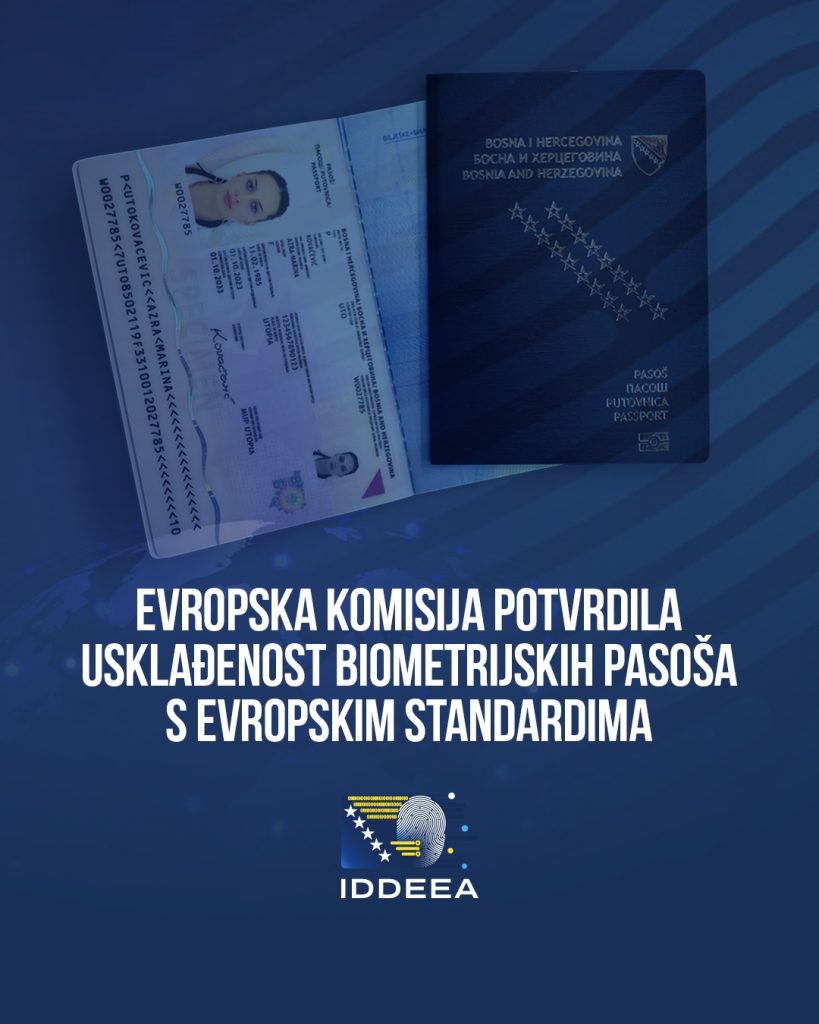
Another significant finding concerns biometric travel documents. The European Commission confirms that the security features, as well as the application and issuance procedures for Bosnia and Herzegovina’s biometric passports, are fully aligned with European standards. This represents important recognition of the level of security achieved by the biometric travel document system, in whose operation IDDEEA plays a key statutory and operational role. At the same time, the Commission points to the need to strengthen oversight of the procurement and production of these documents, identifying this as one of the areas for further institutional improvement.
The European Commission’s Report particularly emphasizes the need to develop electronic identity, ensure the interoperability of electronic signatures, facilitate secure data exchange and advance cross-border digital public services. These are precisely the areas in which IDDEEA is already developing and providing digital identity, qualified electronic signature, electronic identification and secure data exchange services between the competent institutions.
For IDDEEA, the European Commission’s recommendations provide an important framework for the continued development of existing services, their expansion to public institutions, citizens and the business community, and further alignment with European standards, including the European Digital Identity Framework.
“Digital transformation is not merely a matter of introducing new technologies. It also requires legal certainty, citizens’ trust and the ability of institutions to cooperate with one another. Bosnia and Herzegovina already has important elements of state-level digital infrastructure in place. Our task is to further develop this infrastructure, connect it with other institutions and align it with European standards. The European Commission’s Report clearly demonstrates how important these issues are for the European future of Bosnia and Herzegovina,” stated IDDEEA Director, Prof. Dr. Almir Badnjević.
Within the scope of its statutory responsibilities and in cooperation with other competent institutions, IDDEEA will continue its activities aimed at improving digital identity, qualified electronic signatures, the security of identification documents and the interoperability of public information systems. The objective is to ensure that citizens and businesses in Bosnia and Herzegovina have access to secure, simple and reliable digital services developed in accordance with European standards, while further strengthening the existing state-level digital infrastructure as a foundation for Bosnia and Herzegovina’s European integration.